Explosion Proof Overhead Crane Kit vs Standard Crane Kit Guide
menu_open
Content Quick Link
MOST IMPORTANT TAKEAWAY
The key difference between an explosion proof overhead crane kit and a standard crane kit is not only structure or cost—it is the working environment classification. Standard crane kits are designed for general material handling in safe industrial environments, while explosion-proof systems are engineered for hazardous environment cranes where flammable gas, vapor, or dust may exist, making safety certification and ignition prevention the core design priority.
KEY TAKEAWAYS- How to distinguish between explosion proof overhead crane kits and standard crane kits in real industrial use
- Which industries require hazardous environment cranes instead of general material handling cranes
- What components make explosion-proof crane systems fundamentally different
- Why standard crane kits cannot be used in explosive zones
- How cost, maintenance, and certification affect selection decisions
- How to choose the right crane kit based on safety risk, not just lifting capacity
- What is an explosion proof overhead crane kit used for?
- What is included in a standard crane kit for general material handling?
- What makes hazardous environment cranes different from normal industrial cranes?
- Can a standard crane be used in explosive or chemical environments?
- How do explosion-proof crane kits prevent ignition risks?
- What industries require explosion-proof overhead crane systems?
- What is the real cost difference between the two crane systems?
- How should buyers select the correct crane kit for their application?
INTRODUCTION: WHY CRANE TYPE SELECTION IS A SAFETY DECISION, NOT JUST A COST DECISION
In many industrial projects, the first question is often about price. That is normal. But when it comes to overhead lifting equipment, focusing only on cost can lead to the wrong direction. The working environment decides far more than the budget.
An explosion proof overhead crane kit and a standard crane kit may look similar in drawings. Same bridge structure, same runway, similar lifting capacity. But once they are installed in different environments, the difference becomes clear very quickly. One is built for safe workshops. The other is designed for areas where ignition risks may exist.
In practice, crane selection is mainly guided by a few simple but important factors:
- The classification of the working area, whether it is a normal industrial zone or a hazardous zone
- The possibility of flammable gas, vapor, or dust in the air
- Local safety rules and inspection requirements
- How often the crane will operate and under what conditions
It is often said in plant planning meetings: “The crane must fit the environment first, not the budget first.” That idea is worth keeping in mind.
This guide is written to separate the practical differences between explosion proof overhead crane kits and standard crane kits, so buyers can avoid confusion during selection and quotation stages.
STANDARD CRANE KITS FOR GENERAL MATERIAL HANDLING
A standard crane kit is used in common factories and workshops for general material handling. It is a set of crane components designed for environments that are considered safe and stable, where there is no risk of flammable gas, vapor, or combustible dust. In simple terms, it supports everyday lifting tasks in normal production conditions without special environmental protection requirements.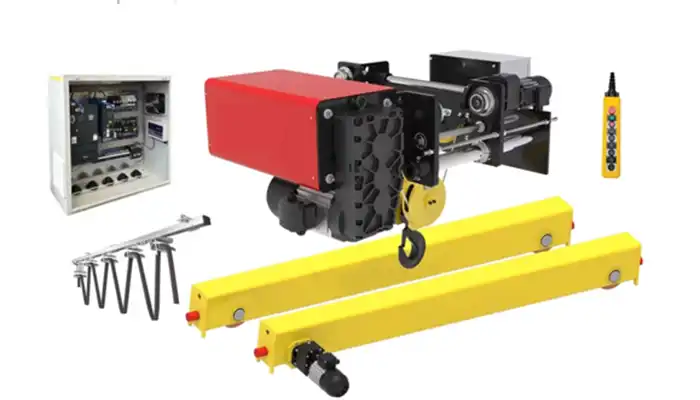
Typical applications of standard crane kits
Standard crane kits are widely used in industries where materials need to be moved regularly, but the working environment does not contain explosion risks or hazardous atmospheric conditions.
Common application areas include:
- Warehouses and logistics distribution centers handling pallets, steel coils, or packaged goods
- Steel structure workshops lifting and positioning fabricated components
- General manufacturing lines such as machinery assembly, automotive parts, and equipment production
In these environments, the air is considered safe under industrial classification, with no flammable gas or explosive dust present during normal operation.
Key characteristics of a standard crane kit
The design of a standard crane kit focuses on stable operation, cost efficiency, and easy maintenance. Since the environment is not classified as hazardous, explosion-proof protection is not included.
- Conventional electrical systems with standard motors and control panels
- Open structural components that are easy to inspect and maintain
- Balanced design between performance, cost, and operational efficiency
- Suitable for general industrial duty cycles in non-hazardous environments
In simple terms, it is a practical lifting solution for factories that require daily material handling without operating in chemical, gas, or dust explosion risk zones.
Practical limitations and usage boundary
Standard crane kits are widely chosen because they are straightforward to install and operate. When the working environment is normal, there is no need to overcomplicate the system with additional safety protection layers.
However, this simplicity also defines its limitation. The system must always remain within safe, non-hazardous industrial conditions. If flammable gas, vapor, or dust risk exists, an explosion-proof crane kit system becomes necessary instead.
WHAT IS AN EXPLOSION PROOF OVERHEAD CRANE KIT?
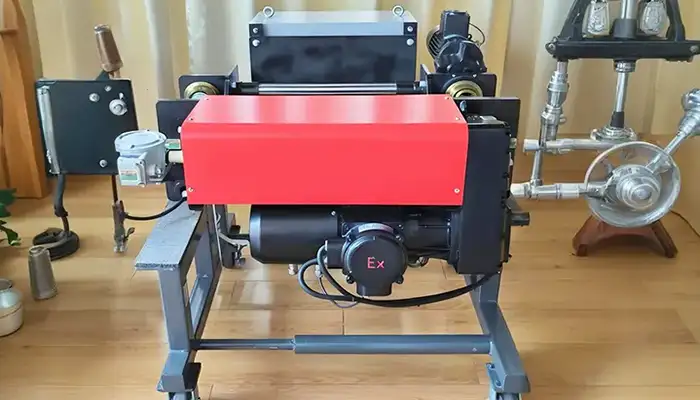
An explosion proof overhead crane kit is a complete lifting system designed for hazardous environment cranes, where the surrounding air may contain flammable gas, vapor, or combustible dust. In these conditions, even a small ignition source can create serious safety risks, so the design focus shifts from only lifting performance to full control of heat, sparks, and electrical discharge.
In simple terms, it is used where normal industrial safety is not enough.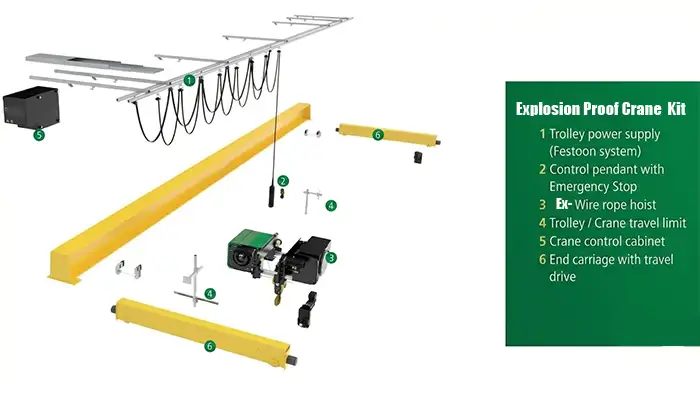 Explosion proof crane kit
Typical industries using explosion proof overhead crane kits
These crane systems are installed in plants where production processes or materials create explosive atmospheres during operation, maintenance, or storage.
Common application areas include:
- Petrochemical and refinery plants where gas and chemical vapors exist during processing
- Oil and gas facilities in refining, storage, and transfer zones
- Paint and solvent workshops where volatile liquids generate flammable fumes
- Grain storage, coal handling, and powder processing industries with combustible dust accumulation
In these environments, the crane becomes part of the overall plant safety control system, not only a material handling tool.
Core design principle of explosion-proof crane kits
The core principle of an explosion proof overhead crane kit is to reduce every possible ignition source to a controlled level. This applies to both mechanical and electrical design.
- Electrical systems designed to prevent sparks during operation or switching
- Motor and enclosure structures engineered to control surface temperature rise
- Grounding and anti-static measures to reduce discharge risk in dust or dry environments
- Sealed or flameproof components to isolate internal electrical parts from external hazardous atmosphere
Each detail is verified according to safety requirements before operation. It is not only a manufacturing process, but also a compliance-driven engineering design.
Safety standards and compliance requirements
Explosion proof overhead crane kits are mandatory equipment in hazardous zones. They must comply with recognized international or regional standards before being used in operation.
- ATEX certification for European hazardous zone requirements
- IECEx system for international explosion-proof classification
- National standards such as GB3836 for industrial safety applications
These standards define behavior under fault conditions, temperature limits, and electrical safety scenarios. Without proper certification, the equipment cannot be legally used in hazardous environment crane applications.
Practical selection logic in real projects
In real engineering projects, an explosion proof crane kit is selected only after the working area has been classified as a risk zone. It is not an upgrade of a standard crane, but a system designed from the beginning for hazardous conditions.
The key idea is matching equipment design with environmental risk level, ensuring safe and stable operation throughout the full lifecycle of the plant.
KEY STRUCTURAL AND ENGINEERING DIFFERENCES
| Category | Explosion Proof Crane Kit | Standard Crane Kit |
|---|---|---|
| Electrical System Design | Uses sealed motors, flameproof enclosures, and anti-spark wiring systems designed to prevent ignition in hazardous environment cranes. Focus is on eliminating sparks, controlling temperature, and isolating electrical risk. | Uses conventional open electrical systems with standard motors and control panels. Designed for general material handling cranes in safe industrial environments. |
| Mechanical Safety Design | Built with non-sparking materials and sealed structures. Mechanical parts are designed to reduce friction-related ignition risk and limit exposure to explosive atmosphere. | Uses general industrial-grade steel components. Focus is on durability and load performance in normal working conditions. |
| Certification Requirements | Requires strict hazardous zone certification such as ATEX, IECEx, or equivalent explosion-proof standards. Approval is mandatory before use in explosive environments. | No explosion atmosphere certification required. Only general industrial safety compliance is needed. |
HAZARDOUS ENVIRONMENT CRANES: WHY STANDARD CRANES CANNOT BE USED
A hazardous environment crane is used in places where the air itself may carry risk, such as flammable gas, vapor, or fine combustible dust. In these zones, lifting equipment is not selected only by load capacity, but must also match the safety classification of the site. An explosion proof overhead crane kit is designed for these conditions, while a standard crane kit is not. In real operation, especially during maintenance and chemical handling, the difference becomes critical.
Why standard crane kits are not suitable in hazardous zones
Standard crane kits are designed for general material handling cranes in normal industrial environments. When used in hazardous areas, the missing protection becomes a serious limitation.
Main reasons include:
- No ignition protection design in electrical or mechanical systems
- No certified explosion resistance for gas or dust environments
- Open electrical components that may generate sparks or heat during operation
- Surface materials and motor structures not controlled for explosion safety limits
- Lack of compliance with hazardous zone classification requirements
These factors make standard cranes unsuitable when flammable substances are present in the working area.
Practical safety consideration in real industrial operation
In chemical plants, oil facilities, and powder-processing industries, equipment selection is strictly based on hazardous zone classification before installation.
From an engineering perspective, installing a standard crane kit in a hazardous zone creates two major issues:
- It does not meet certification requirements such as ATEX or IECEx
- It introduces uncontrolled ignition risks during normal operation or fault conditions
In real project execution, this is not just an equipment mismatch—it is a compliance issue because the system does not meet the required safety level of the environment.
Key understanding for buyers and engineers
A common misunderstanding is that explosion-proof cranes are simply upgraded versions of standard cranes. In reality, they are designed based on a completely different safety logic.
To summarize:
- Standard crane kits are suitable only for safe, general material handling environments
- Hazardous environment cranes require explosion proof overhead crane kits with certified protection systems
- Selection is determined by site classification, not by lifting capacity or budget preference
Once the working area is defined as hazardous, the crane type is no longer optional—it becomes a requirement for safe operation.
COST, MAINTENANCE, AND LIFECYCLE DIFFERENCES
When comparing an explosion proof overhead crane kit with a standard crane kit, the difference is not only in purchase price. It also appears in maintenance requirements, inspection routines, and long-term operational behavior. Buyers often realize this after installation, when the crane starts operating under real production conditions and duty cycles.
Explosion Proof Overhead Crane Kit
An explosion proof overhead crane kit is built with certified components and stricter safety control requirements. Because of this, both cost structure and lifecycle management follow a more controlled engineering process.
Key points include:
- Higher initial investment due to explosion-proof certified motors, electrical systems, and control components
- Additional cost related to compliance testing, certification, and approval before delivery and installation
- Strict maintenance requirements with scheduled inspection of flameproof enclosures, sealing, and electrical protection
- Spare parts must match certified specifications, limiting substitution flexibility
- Longer production, testing, and approval cycle before the system is fully ready for operation
In practice, maintenance is not only routine servicing. It is part of the safety assurance system, especially in hazardous environment cranes where operating conditions must remain within strict safety limits.
Standard Crane Kit
A standard crane kit is designed for general material handling cranes in normal industrial environments. The focus is on simplicity, fast deployment, and lower operating cost.
Key points include:
- Lower purchase cost compared to explosion-proof systems
- Faster delivery and simpler installation process
- Easier maintenance with widely available standard spare parts
- Flexible repair and replacement without certification restrictions
- Suitable for continuous use in non-hazardous production environments
Because there are fewer regulatory constraints, maintenance is usually straightforward and can be handled by standard industrial maintenance teams without special certification requirements.
Practical comparison in lifecycle use
In real operation, the difference becomes more obvious over time. Explosion-proof systems require structured lifecycle control, while standard cranes allow more operational flexibility.
- Explosion-proof systems prioritize safety compliance throughout the entire service life
- Standard crane kits prioritize cost efficiency and operational simplicity
- Maintenance planning is stricter for hazardous environment cranes and more flexible for general material handling cranes
This is why selection should consider not only initial investment, but also long-term maintenance strategy and lifecycle management within the plant.
HOW TO CHOOSE BETWEEN STANDARD AND EXPLOSION-PROOF CRANE KITS
Choosing between a standard crane kit and an explosion proof overhead crane kit should not start from load capacity or price. In most industrial projects, the first step is always to clearly understand the working environment. Once the environment is defined, the selection becomes more structured and technically straightforward. Many mismatches happen because environmental conditions were not properly evaluated at the beginning.
Whether the working area is hazardous or non-hazardous
This is the starting point of any crane selection process.
- If the area is a normal workshop or warehouse, a standard crane kit for general material handling cranes is usually sufficient
- If there is any possibility of flammable gas, vapor, or dust accumulation, the area is classified as a hazardous environment crane application
This classification is usually defined by safety documentation, plant design reports, or local inspection authorities.
A common engineering principle is simple: if the air requires safety classification, the crane must follow the same classification.
Type of industry and process characteristics
Different industries naturally lead to different crane system requirements.
- Chemical and refinery plants often require explosion proof overhead crane kits due to vapor and gas risks
- Oil and gas facilities usually fall under hazardous environment crane requirements
- Steel workshops and assembly plants typically use standard crane kits
- Logistics centers mainly rely on general material handling cranes
In many cases, the industry type already provides a strong indication before detailed technical evaluation begins.
Required lifting capacity and duty cycle
Load capacity is important, but it is not the primary decision factor.
- Both standard and explosion-proof crane kits can be designed for similar tonnage ranges
- Duty cycle (frequency of operation) affects motor selection and structural design
- Heavy-duty continuous operation may require upgraded configuration regardless of crane type
However, even high lifting capacity does not justify using a standard crane in a hazardous environment.
Safety compliance and regulatory requirements
In many industrial projects, crane selection is directly connected to compliance requirements.
- Explosion-proof systems must comply with standards such as ATEX or IECEx depending on region
- Hazardous zone classification (Zone 1, Zone 2, Zone 21, Zone 22) defines equipment requirements
- Inspection and approval are required before commissioning in regulated environments
This is not optional. It is part of legal operation and plant acceptance procedures.
Long-term operational risk tolerance
Some decisions are not only technical, but also related to how much operational risk a plant is willing to manage over time.
- Explosion proof overhead crane kits reduce ignition-related operational risks in sensitive environments
- Standard crane kits are suitable where environmental risks are already controlled
- Maintenance planning, shutdown safety, and inspection audits all influence the final choice
In long-term operation, risk control often becomes more important than initial investment difference.
Key decision principle
In real engineering practice, the core rule is clear:
The decision is not based on lifting capacity or price.
It is based first on environment classification and safety requirements.
Once the working environment is correctly identified, choosing between a standard crane kit and an explosion proof overhead crane kit becomes a technical confirmation rather than a guess.
PRACTICAL INDUSTRIAL APPLICATION IMPACT
In real industrial use, the difference between an explosion proof overhead crane kit and a standard crane kit becomes clear only when the plant starts daily operation—during loading, maintenance, and continuous production cycles, not just in design drawings or specifications. Both systems perform well, but in completely different environments.
Explosion-proof crane systems in industrial use
Explosion-proof crane systems are mainly installed in hazardous environment cranes applications, where safety rules are strict and environmental risk cannot be ignored.
In these conditions, the crane is not only a lifting tool—it becomes part of the plant's overall safety structure.
Key practical impacts include:
- Safe operation in areas where gas, vapor, or combustible dust may exist
- Stable performance under strict operating restrictions and safety supervision
- Compliance with industrial safety standards required for plant approval and audits
- Lower risk of ignition-related incidents during lifting, maintenance, or emergency handling
In chemical plants and oil-related facilities, these systems are often essential not only for production efficiency, but also for passing safety inspections and maintaining continuous operation.
Standard crane systems in industrial use
Standard crane kits are widely used in general material handling crane environments where working conditions are stable and non-hazardous.
Their role is more direct and practical—supporting daily production flow without additional safety classification constraints.
Key practical impacts include:
- Efficient material movement in workshops, warehouses, and assembly lines
- Lower investment cost, supporting wider equipment coverage within a plant
- Faster installation and easier adjustment during production layout changes
- Flexible use across different lifting tasks without strict regulatory limitations
In many factories, standard crane systems are selected because they allow production capacity to scale quickly without complex approval processes.
Practical difference in real operation
When both systems are in operation, the difference is not only technical—it is also about how the entire plant is managed day to day.
- Explosion-proof crane systems focus on controlled operation in risk-sensitive environments
- Standard crane systems focus on efficiency and flexibility in normal industrial workflows
- One prioritizes safety compliance, the other prioritizes production flow
This is why both systems exist side by side in industry. They are not competing solutions—they are designed for different working realities.
FAQ: EXPLOSION PROOF OVERHEAD CRANE KIT VS STANDARD CRANE KIT IN PRACTICAL USE
This FAQ section explains the practical differences between explosion proof overhead crane kits and standard crane kits, focusing on real industrial use, safety requirements, and selection logic in hazardous and non-hazardous environments.
What is an explosion proof overhead crane kit used for?
A: It is used for lifting and material handling in areas where explosive gas, vapor, or dust may be present.
It is commonly installed in chemical plants, oil refineries, solvent workshops, and powder handling zones where safety control is required during every lifting operation. The crane is selected to ensure stable operation even when the surrounding atmosphere is not completely safe.
What is included in a standard crane kit for general material handling?
A: It is a complete set of crane components designed for normal industrial lifting in safe workshop environments.
Typically, it includes the bridge structure, end carriages, hoisting unit, and electrical control system. These systems are widely used in warehouses, steel workshops, and production lines where no flammable atmosphere risk exists.
What makes hazardous environment cranes different from normal industrial cranes?
A: They are designed with protection systems that control ignition sources in risky working areas.
Instead of open electrical parts, they use sealed or flameproof components, controlled motor temperature, and anti-spark design features. Normal industrial cranes do not include these safety functions because they are not intended for explosive conditions.
Can a standard crane be used in explosive or chemical environments?
A: No, it is not suitable for those conditions.
A standard crane kit is built for general material handling in safe environments. In areas with flammable gas or dust, it does not meet safety requirements and cannot pass hazardous zone inspection in most industrial regulations.
How do explosion-proof crane kits prevent ignition risks?
A: They are designed to reduce or isolate any possible source of spark or heat.
This is achieved through sealed electrical enclosures, flameproof motors, anti-static grounding, and controlled surface temperature design. These measures work together to prevent accidental ignition during operation.
What industries require explosion-proof overhead crane systems?
A: Industries with flammable substances or explosive dust conditions require them.
This includes petrochemical production, oil and gas facilities, paint and coating workshops, and bulk material handling such as grain or coal storage. These environments are classified as hazardous zones under industrial safety standards.
What is the real cost difference between the two crane systems?
A: Explosion-proof systems usually require a higher investment than standard crane kits.
The difference comes from certified components, stricter testing, and compliance requirements for hazardous environments. Standard cranes are more economical because they use conventional parts without explosion protection certification.
How should buyers select the correct crane kit for their application?
A: Selection should always start from working environment classification, not lifting capacity.
If the area is a normal workshop or warehouse, a standard crane kit is sufficient for general material handling. If the environment involves gas, vapor, or dust risk, an explosion-proof overhead crane kit is required to meet safety and compliance conditions.
GET YOUR TAILORED DESIGN
The comparison between an explosion proof overhead crane kit and a standard crane kit is fundamentally a comparison between risk-controlled engineering systems and general material handling equipment.
- Standard crane kits are designed for efficiency in safe environments
- Explosion-proof crane kits are designed for survival in hazardous environments
For industrial buyers, the correct selection is not optional—it directly determines plant safety, regulatory compliance, and long-term operational stability.

Article by Bella ,who has been in the hoist and crane field since 2016. Bella provides overhead crane & gantry crane consultation services for clients who need a customized overhead travelling crane solution.Contact her to get free consultation.